Most small and mid-sized companies already have the pieces of a marketing funnel: some ads, a website, a newsletter, a sales inbox. What they lack is the connection between them. Visitors arrive, look around, and leave, and nobody can say where they dropped off.
A marketing funnel is the path a stranger takes to become a customer, broken into stages so you can plan content, offers, and follow-up for each one. A funnel converts when the ask matches the stage: education for new visitors, proof for people comparing options, and a low-friction offer for people ready to buy.
This guide is for founders and marketing or operations leads. You will learn the main sales funnel stages, what content and offers fit each, which parts to automate first, how to measure drop-off, and two simple examples you can adapt.
What a marketing funnel actually is
The funnel shape reflects a simple fact: more people hear about you than will ever buy. Each stage filters the audience down, and your job is to help the right people move forward while poor fits leave early.
Some teams use AIDA (attention, interest, desire, action), others say top, middle, and bottom of funnel. The labels matter less than agreeing internally on what a “lead” is. This guide uses four stages: awareness, consideration, decision, and retention.
Sales funnel stages and what fits each
Awareness: be useful before you sell
People at this stage have a problem but may not know your company exists. They want answers, not a pitch. Search-focused blog posts, short videos, social posts, and practical guides work well here. Offers should be free and ask for nothing: a checklist, a calculator, a template.
Asking for too much too soon is the common error. A “Book a demo” button on a first blog visit rarely converts; a related article or newsletter signup usually does better.
Consideration: help them compare
Now the visitor is weighing solutions and wants specifics: how your approach works and how it compares to alternatives. Comparison pages, case studies, webinars, and product tours fit this stage.
This is where gated offers make sense: someone trades an email address for something clearly valuable, such as an in-depth report, a template pack, or a free audit.
Decision: remove friction
The person is ready to act and is looking either for reasons to trust you or reasons to hesitate. Pricing pages, reviews, free trials, consultations, and focused landing pages belong here. For a detailed checklist on that last item, see our guide to landing page best practices.
Every extra form field, slow page, or vague button costs conversions here. “Book a 30-minute call” tells people what happens next; “Learn more” does not.
Retention: the stage most funnels forget
A customer who buys once and never hears from you again is a missed opportunity. Onboarding emails, how-to content, check-ins, loyalty offers, and referral programs keep customers engaged. Referrals also feed the top of the funnel, which is why some teams draw it as a loop.
The funnel at a glance
| Stage | Goal | Typical channels | Content and offers | Key metric |
|---|---|---|---|---|
| Awareness | Reach the right audience | SEO, social, paid social, video | Blog posts, short videos, free checklists | New users, cost per click |
| Consideration | Capture and qualify leads | Email, retargeting, webinars, search ads | Case studies, comparisons, gated guides | Lead conversion rate, cost per lead |
| Decision | Turn leads into customers | Landing pages, sales calls, email | Trials, demos, consultations, pricing | Lead-to-customer rate, cost per acquisition |
| Retention | Keep and grow customers | Email, in-app messages, account management | Onboarding, loyalty offers, referrals | Repeat purchase rate, churn, lifetime value |
Pick one primary metric per stage. Tracking twenty numbers usually means acting on none of them.
Funnel automation: what to set up first
Automation will not rescue a weak offer, but it makes sure nobody falls into the gap between a download and a sales conversation. Some teams set it up in-house; others bring in a digital marketing partner. Either way, start with three pieces.
Email sequences for lead nurturing
Lead nurturing means building trust with people who are interested but not ready to buy. A simple sequence after a download might run five emails over two to three weeks:
- Deliver the resource and say what to expect next.
- Share a related tip or a common mistake.
- Show a short example or case study.
- Answer the most common objection.
- Make a clear, low-pressure offer, such as a call or a trial.
Trigger messages by behavior where you can: someone who viewed pricing twice deserves a different email than someone who opened one newsletter. Follow the consent rules in your markets (GDPR and UK GDPR in Europe, CAN-SPAM in the US).
Retargeting
Retargeting shows ads to people who already visited your site or engaged with your content. Segment it by stage: a blog reader should see a helpful guide, while a cart abandoner should see the product they left behind. Cap frequency and exclude recent buyers.
CRM handoff
The handoff from marketing to sales is where many B2B funnels leak. Agree on what makes a lead sales-ready (for example, a demo request), route those leads automatically to the right person in your CRM with their history attached, and measure response time.
If your tools do not talk to each other, a small integration through custom software development can close the gap. Our guide to workflow automation for small businesses covers where to start.
Measuring drop-off between stages
Drop-off is the share of people who reach one step but not the next. Say 2,000 people visit a landing page, 100 fill in the form, and 10 become customers: the page converts at 5% and leads close at 10%. Now you can judge which number needs work.
To measure it:
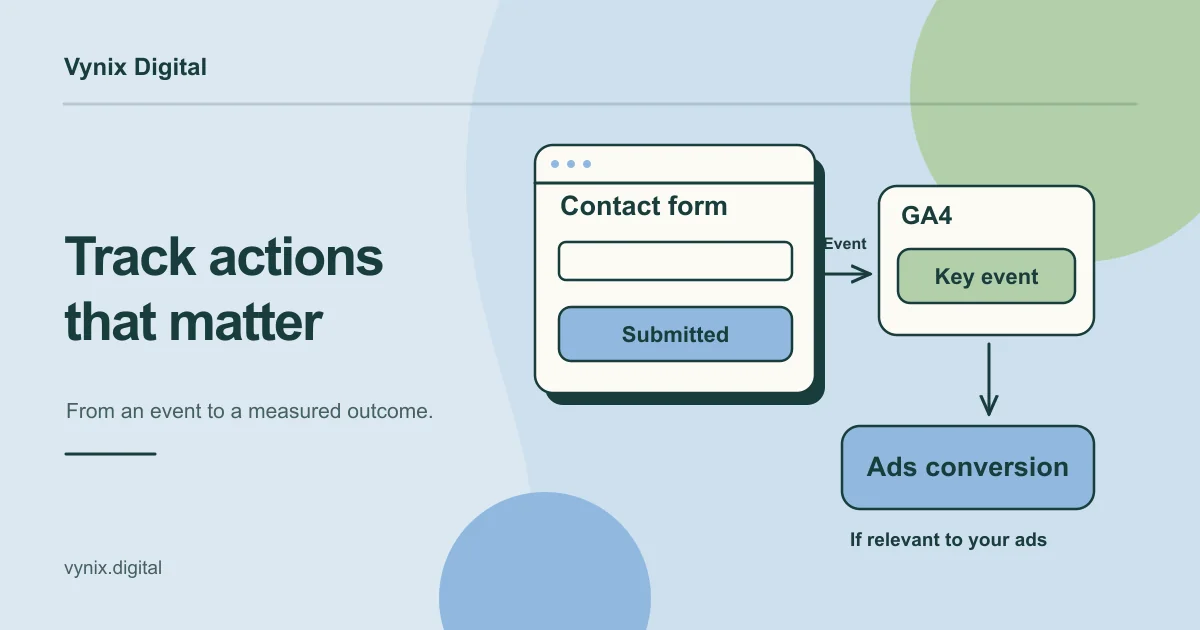
- Define each step as a trackable event: page view, form submit, trial start, purchase.
- Mark those events as conversions in your analytics. Our GA4 conversion tracking guide walks through the setup.
- Build a funnel report. GA4’s funnel exploration lets you define up to 10 steps and choose an open funnel (people can enter at any step) or a closed one (they must start at step one).
- Bring in CRM data for later stages, since sales calls and contracts happen outside your website.
- Review monthly and fix the biggest leak first, changing one thing at a time. Our guide on how to run an A/B test keeps you from guessing.
Two simple funnel examples
B2B: project management software for agencies
- Awareness: blog posts and LinkedIn content on agency resourcing and client reporting, plus search ads on high-intent terms.
- Consideration: a gated capacity planning template. Each download starts a five-email nurture sequence, and visitors see retargeting ads that point to a comparison page.
- Decision: a demo booking page. When a lead books a demo or views pricing twice, the CRM assigns them to a rep who can see their email and page history.
- Retention: onboarding emails during the first month, a check-in call around day 60, and a referral offer for satisfied accounts.
The metrics to watch are template download rate, lead-to-demo rate, and demo-to-customer rate.
Ecommerce: a skincare store
- Awareness: short-form video, creator content, paid social, and search content answering common skincare questions.
- Consideration: a skin-type quiz that recommends products and asks for an email to send the results, followed by a welcome series with a first-order offer.
- Decision: clear product pages with reviews, visible shipping costs, and a short checkout. Abandoned cart emails and retargeting ads bring back people who left.
- Retention: post-purchase tips on using the product, a replenishment reminder timed to when it usually runs out, and a loyalty or referral program.
The decision stage deserves extra care. Baymard Institute puts the average documented cart abandonment rate at about 70%, and extra costs such as shipping, taxes, and fees are the top reason shoppers give for abandoning during checkout, so show total costs early. Watch quiz completion, add-to-cart, checkout completion, and repeat purchase rates.
Common mistakes
- Treating every visitor as ready to buy. Hard sells aimed at first-time readers push people away.
- Collecting leads with no follow-up. A form that drops emails into a spreadsheet nobody reads is a leak.
- Measuring only the top. Track leads, customers, and revenue, not just traffic.
- Sending everyone the same message. A new subscriber and a returning customer need different emails.
- Building too much at once. Get one simple sequence working before adding branches.
- Fixing the wrong stage. More traffic will not help if the landing page converts poorly. If your site gets visitors but few inquiries, our guide on why a website is not generating leads covers the usual causes.
- Ignoring retention. Many funnels stop at the first purchase and never ask for the second.
Start small, then build
A marketing funnel that converts comes down to fit: the right offer at each stage, follow-up so interested people do not go cold, and measurement that shows where they leave. Start with one funnel for your most important offer. Map the four stages, set up one nurture sequence and one retargeting audience, track each step, and fix the biggest drop-off first.
If you want help planning or building it, our digital marketing services cover performance marketing, conversion rate optimization, automated funnels, and landing pages. Get in touch to talk through your funnel and where it is leaking.